Ambassador Lagumdžija Addresses the UN Panel Discussion on Holocaust Remembrance and the Preservation of Cultural Heritage
New York, 4 November 2026
 At the panel discussion entitled “Understanding Past Realities of the Holocaust: Photography versus Art,” held on 4 November 2026 at the United Nations Headquarters in New York, the Permanent Representative of Bosnia and Herzegovina to the United Nations, Ambassador Zlatko Lagumdžija, highlighted the enduring importance of preserving cultural heritage, historical memory and the identity of peoples, particularly in the context of persecution, the systematic destruction of cultural property and attempts to erase historical heritage.
The event was organized by the United Nations Holocaust and the United Nations Outreach Programme, in cooperation with the Fritz Ascher Society for Persecuted, Ostracized and Banned Art and 1014 / space for ideas, with the support of the Permanent Mission of the Federal Republic of Germany to the United Nations.
The panel was held in remembrance of the victims of the November Pogrom of 1938, known as Kristallnacht (the Night of Broken Glass), when the Nazi regime organized mass attacks against Jewish communities throughout Germany, annexed Austria and the Sudetenland on 9 and 10 November. During this pogrom, thousands of Jewish homes and business premises were destroyed, more than a thousand synagogues were burned or damaged, and approximately 30,000 Jewish men were deported to concentration camps. These events marked a dramatic escalation of state-sponsored antisemitism and the persecution of Jews.
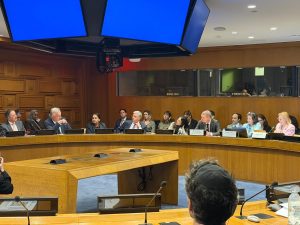 Opening remarks were delivered by Ms. Melissa Fleming, United Nations Under-Secretary-General for Global Communications; H.E. Florian Laudi, Deputy Permanent Representative of Germany to the United Nations; and Ms. Rachel Stern, Executive Director of the Fritz Ascher Society. Historians Dr. Christoph Kreutzmüller and Dr. Rachel Perry analyzed visual representations of the November Pogrom, examining how photography and art contribute to an understanding of historical crimes, social relations and the experiences of individuals subjected to violence.
In his address, Ambassador Lagumdžija noted that the presentations by the panelists inevitably brought to mind his personal experience of the events of the 1990s in Bosnia and Herzegovina, particularly the deliberate shelling and burning of the National and University Library of Bosnia and Herzegovina, housed in Sarajevo City Hall, in 1992.
He emphasized that Kristallnacht and the burning of Sarajevo City Hall belong to different historical and geopolitical contexts, but that both events represent examples of the deliberate destruction of cultural heritage as part of broader campaigns of persecution and attempts to erase the identity of a people.
“The destruction of cultural heritage goes far beyond the physical loss of buildings, books or monuments. It strikes at the very foundations of collective memory, cultural identity and historical continuity,” Ambassador Lagumdžija stated.
He recalled that the fire at Sarajevo City Hall destroyed approximately two million books, rare manuscripts, archival materials and other publications, representing almost 80 percent of the library’s collection. This resulted in the irretrievable loss of an invaluable part of the cultural and historical heritage of Bosnia and Herzegovina, which bore witness to centuries of different historical periods and cultural traditions.
He stressed that the destruction of City Hall was not merely an attack on a library, but also an attempt to erase the history, identity, literature and cultural presence of a people.
In this context, Ambassador Lagumdžija recalled the warning attributed to German poet Heinrich Heine: “Where they burn books, they will ultimately burn people,” emphasizing that history, with its enormous human and civilizational losses, has demonstrated how important it is to recognize and stop such processes in time.
Speaking about the other side of Bosnia and Herzegovina’s historical experience, the Ambassador specifically highlighted the example of the Sarajevo Haggadah, one of the most precious manuscripts of Jewish and European cultural heritage. This extraordinary manuscript, which passed through Italy following the expulsion of Jews from Spain in 1492 before eventually arriving in Sarajevo, survived both the Holocaust and the war in Bosnia and Herzegovina.
During the Second World War, the Sarajevo Haggadah was saved from Nazi confiscation through the courage and determination of Derviš Korkut, Director and Curator of the National Museum of Bosnia and Herzegovina. During the siege of Sarajevo in the 1990s, the manuscript was once again preserved, this time in a bank vault, thereby preventing its destruction.
“These two stories, one of devastating loss and the other of extraordinary preservation, remind us that attempts to erase the identity and history of a people do not always succeed,” Lagumdžija stated.
He emphasized that protecting cultural heritage entails much more than the physical preservation of historical objects. It means preserving collective memory, defending cultural identity and ensuring that the history and contributions of all peoples are preserved for future generations.
“Preserving cultural heritage is not merely an act of protection and preservation. It is an act of resistance, resilience and an affirmation of our shared humanity,” the Ambassador stated.
The message of Bosnia and Herzegovina, as underscored in his address, is that the destruction of cultural heritage and material assets does not merely destroy the past of a people; it also jeopardizes the right of future generations to know their own history and understand our shared human heritage.