Ambassador Lagumdžija at the UN: Global AI Governance Must Be Anchored in the United Nations
New York, 31 July 2026
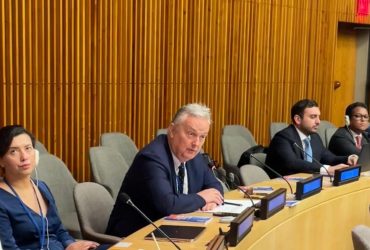
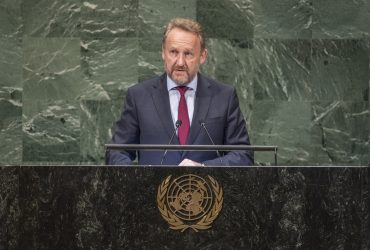
 As an EU candidate country, Bosnia and Herzegovina believes that global AI governance must remain anchored in the United Nations and guided by international law, human rights, transparency, accountability and human oversight, Ambassador Dr. Zlatko Lagumdžija, Permanent Representative of Bosnia and Herzegovina to the United Nations, said at a briefing on the outcomes of the 2026 World Artificial Intelligence Conference. He emphasized that these principles are essential to ensuring the development of more robust and beneficial AI.
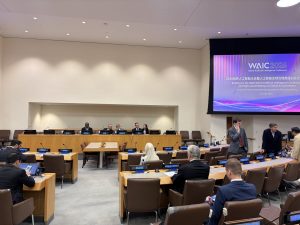
The briefing was held at UN Headquarters in New York following the World Artificial Intelligence Conference and the High-Level Meeting on Global AI Governance, held in Shanghai from 17 to 20 July. Participants were presented with the conference’s main outcomes, the establishment of the World Artificial Intelligence Cooperation Organization—WAICO—and initiatives aimed at building the capacities of developing countries.
China’s Permanent Representative to the UN, Ambassador Fu Cong, presented five elements of China’s approach: integrating innovation, safety and global governance; keeping artificial intelligence under human control; preventing the technological divide from widening; establishing WAICO; and preserving the UN as the central platform for global dialogue. The initiatives announced also include 5,000 AI training opportunities, the establishment of six AI application centres and the expansion of the MAZU meteorological early-warning system to 30 countries.
 Ambassador Lagumdžija stated that WAICO’s lasting contribution would depend on its openness, transparency and inclusiveness, as well as its ability to complement, rather than duplicate, the existing United Nations architecture. He proposed considering the International Atomic Energy Agency as a possible model for a global regulatory framework adapted to the specific characteristics of artificial intelligence.
“We should not copy the IAEA, but explore an IAEA-inspired mechanism adapted to AI,” Lagumdžija said. Such a mechanism could assess advanced systems and cross-border risks, develop standards for safety testing, audits and incident reporting, and assist developing countries in building institutions and technical expertise.
He particularly emphasized that capacity-building must not be a one-way process.
“Capacity-building does not mean that some countries write the rules while others are trained merely to follow them. Every Member State must have a voice in shaping those rules,” he said.
Lagumdžija requested clarification regarding future cooperation between WAICO and the UN, as well as the possibility of using relevant United Nations platforms and entities to explore a mechanism combining AI safety, accountability and capacity-building.
Responding to the question, UN Under-Secretary-General and Special Envoy for Digital and Emerging Technologies Amandeep Singh Gill pointed out that WAICO’s founding agreement is based on the purposes and principles of the UN Charter. He said this provides a foundation for connecting WAICO with existing United Nations processes, with new initiatives complementing rather than replacing the UN’s universal political, scientific and legal architecture.
Gill also warned that excessive regulation could slow the development of beneficial AI applications, while emphasizing that no country can independently manage the technology’s cross-border risks. Representatives of Zambia drew attention to the lack of computing infrastructure in the Global South, while Dr. Song Haitao underscored the importance of open-source AI and stated that artificial intelligence should not divide the world.
“Transformative power without common rules creates common insecurity. AI must become neither the privilege of a few nor a danger to all, but a shared instrument of human progress under shared international responsibility,” Ambassador Lagumdžija concluded.
Intervention of ambassador Ladumdžija:
PERMANENT MISSION OF BOSNIA AND HERZEGOVINA
TO THE UNITED NATIONS
INTEREVENTION
by
H.E. Mr. Zlatko Lagumdžija
Permanent Representative of Bosnia and Herzegovina to the United Nations
at
Briefing on the 2026 World Artificial Intelligence Conference and High-Level Meeting on Global AI Governance
(31 July 2026, 10:00-11:30AM, CR1 of UNHQ)
CHECK AGAINST DELIVERY
New York
31 july 2026
PERMANENT MISSION OF BOSNIA AND HERZEGOVINA TO THE UNITED NATIONS
211E 43rd STREET, SUITE 1701, NEW YORK, NY 10017 – TEL (212)751-9015-FAX(212)751-9019
Thank you, Mr. Chair.
Bosnia and Herzegovina welcomes the Shanghai Conference’s people-centred approach, particularly its recognition that global AI governance and capacity-building are inseparable. As an EU candidate country, we believe that progress must remain anchored in the United Nations and grounded in international law, human rights, transparency, accountability and human oversight in the search for more robust and beneficial AI.
The establishment of the World Artificial Intelligence Cooperation Organization and the conference’s action plans demonstrate movement from principles towards practical cooperation.
Their lasting contribution will depend on being open, transparent and inclusive; grounded in international law and human rights; engaging governments, industry, academia and civil society; and complementing, rather than duplicating, the universal architecture anchored in the United Nations.
We should consider the International Atomic Energy Agency as a potential model for a global AI regulatory framework. The IAEA recognizes that transformative technologies offer great benefits, but also create risks no country can manage alone. It combines safeguards with technical cooperation.
We are aware of the fact that the artificial intelligence is different: it is decentralized, largely developed by private actors and evolving at exceptional speed. Of course we should not copy the IAEA, but explore an IAEA-inspired mechanism adapted to AI.
Such a mechanism could assess advanced systems and cross-border risks; develop standards for safety testing, audits, incident reporting and human oversight; and help developing and smaller countries build institutions, expertise, computing capacity and useful applications.
Capacity-building does not mean that some countries write the rules while others are trained merely to follow them. Every Member State must have a voice in shaping those rules.
The UN Global Dialogue on AI Governance, the Independent International Scientific Panel, capacity-building mechanisms and WAICO should reinforce one another, and not be fragmented or competing structures.
In this regard, I would welcome the views of our distinguished speakers on the following question:
How does WAICO envisage cooperation between WAICO and the UN, including safeguards for transparency, human rights and multistakeholder participation and what are the expected time frames?
And how could the relevant UN platforms and entities be used to explore an IAEA-inspired mechanism combining AI safety, accountability and capacity-building?
Transformative power without common rules creates common insecurity. In the age of artificial intelligence, we must learn that lesson before, not after the consequences become irreversible. AI must become neither the privilege of a few nor a danger to all, but a shared instrument of human progress under shared international responsibility.
Thank you.