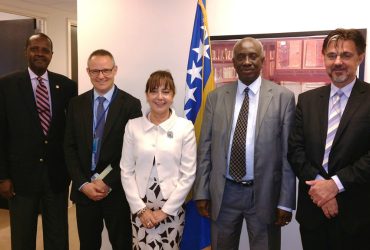
Bosnia and Herzegovina at the Helm of the Eastern European Group at the United Nations – Strengthening Coordination and a Common Approach
 Bosnia and Herzegovina assumed the chairmanship of the Eastern European Group (EEG) at the United Nations in New York in December 2025. The EEG (Albania, Armenia, Azerbaijan, Belarus, Bosnia and Herzegovina, Bulgaria, Croatia, Czech Republic, Estonia, Georgia, Hungary, Latvia, Lithuania, Moldova, Montenegro, North Macedonia, Poland, Romania, Russian Federation, Serbia Slovak Republic, Slovenia and Ukraine) is one of the five regional groups within the UN system and brings together countries from Eastern and South-Eastern Europe, the Caucasus, and parts of Central Asia. The Group plays an important role in coordinating common positions, allocating posts within United Nations bodies, as well as in nominations and elections for various positions across the UN system.
The work of the EEG is based on regular consultations among Permanent Representatives and their teams, with the aim of achieving consensus on issues of common interest, enhancing mutual cooperation, and strengthening the visibility and influence of the Group within multilateral processes. Particular importance is attached to coordination during UN electoral processes, as well as to a common approach in relevant thematic areas. At present, the functioning of the EEG is carried out in a limited capacity, primarily due to difficulties in achieving consensus among certain member states. This situation largely stems from the repercussions of the conflict between the Russian Federation and Ukraine, which is also reflected in the work of regional groups within the United Nations. The lack of agreement on certain issues affects the efficiency of decision-making and the Group’s common action, further underscoring the need for intensified political dialogue and the strengthening of internal coordination mechanisms.
The Permanent Mission of Bosnia and Herzegovina to the United Nations actively participates in the work of the EEG and contributes to its internal coordination. The Ambassador of Bosnia and Herzegovina to the United Nations, Mr. Zlatko Lagumdžija, plays a prominent and widely recognized role in this process, acting as an active coordinator and interlocutor among the Group’s members, with the aim of strengthening mutual trust and enhancing the effectiveness of the EEG.
 In this context, Ambassador Lagumdžija yesterday hosted a traditional working lunch for the ambassadors and permanent representatives of the EEG member states to the United Nations. All member states of the Group attended the working lunch, confirming their interest and readiness for open and constructive dialogue. The discussions took place in a positive and working atmosphere, with a particular focus on the need for further harmonization of positions, improved internal coordination, and a long-term commitment to more efficient and substantive functioning of the EEG within the United Nations.
In his address to the participants, Ambassador Lagumdžija underscored the importance of the EEG as a relevant regional actor within the UN system, noting that its potential has not yet been fully utilized. He particularly referred to the experience of Bosnia and Herzegovina, which demonstrates that even parties with opposing interests can, with political will and responsibility, find ways to subordinate their work to the overall benefit of the state. The Ambassador assessed that such an approach should be further encouraged within the work of the EEG, with a view to strengthening mutual understanding, building consensus, and achieving a stronger and more coordinated joint presence in key areas of activity at the United Nations.
It was concluded that Bosnia and Herzegovina’s chairmanship of the EEG in December 2025 represents an opportunity to further enhance the Group’s work, strengthen its cohesion, and contribute to more visible and effective engagement within the multilateral UN system.